
I have recently been watching a Netflix series called The English Game. Like many series that are based on truth, it takes a number of disparate facts and combines them together to make a story that contains the essence of the facts, but is nevertheless a work of fiction. The story is about a football club called Blackburn, run by a mill owner who ‘buys in’ football talent, including an England International called jack Hunter, and a Scotsman called Fergus Suter. His team become the first working class team to win the FA Cup when they beat Old Etonians at the Kennington Oval in 1883.
When I came to look into the facts behind the story I found two separate stories melded together. The series was faithful to the story of Fergus Suter, except the team he joined was Blackburn Rovers, with whom he won the cup three times in 1884-6. However the team that beat Old Etonians in 1883 was Blackburn Olympic, whose player-coach was Jack Hunter.
However, to my disappointment, the series made no mention of the Blackburn Olympic captain, the first captain of a working class team to lift the cup. His name was Squire Albert Warburton.
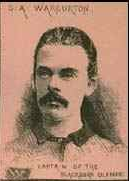
The following information is taken from his Wikepedia entry: Squire Albert Warburton (26 January 1856 – 24 November 1925) was an English footballer born in Oldahm, Lancashire. “Squire” was not a title but his actual first name, although he was known by his middle name.
Albert was the captain of the Blackburn Olympic team which defeated Old Etonians in the FA Cup Final on 31 March 1883. The cup had previously been won solely by teams of wealthy amateurs from London and the south. At a civic reception upon the team’s return to Blackburn Warburton reportedly proclaimed “The Cup is very welcome to Lancashire. It’ll have a good home and it’ll never go back to London”.

In the match report in the Blackburn Times on 6 April 1883, Warburton was described as a “Master plumber; also pub landlord and poulterer”.[1] He was working as a publican at the time of the First World War. He died on 24 November 1925.
The following chronicle of the match appeared in The Morning Post, and is from the Wikepedia entry for the 1883 Cup Final:
The deciding trial in the competition came off at Kennington-Oval on Saturday. The attendance was very large. In the first half the Old Etonians scored a goal, kicked by Goodhart, but matters were balanced when Massie got the leather through. At the call of time the score stood at a goal each, and then the extra half-hour was entered upon. A very exciting struggle followed, and at about 15 minutes from the call of time Costley headed the ball through, and no further score being made, Blackburn were winners by two goals to one. The Cup was presented by Major Marindin, and Mr Coddrington, MP for Blackburn, acknowledged the compliment on behalf of the winners. The Etonians suffered a severe loss through Dunn getting damaged during the first half, but, by way of a set-off, the Blackburn team had three of their men crippled. It was a grandly-contested trial, and the Blackburn men won by fast play and good condition.[4]— The Morning Post (London), 2 April 1883.
Searching the net for further information I found a short story by Christopher Hall called The Squire of Kennington Oval. I also found an item from the Lancashire Telegraph of 16th march 2007. Which included the following:
Formed by a mill owner, Olympic brought the Cup to the north for the first time, during a blaze of glory lasting 12 years. Their 1883 triumph, and how the club overcame the Old Etonians, is brought to life by writer Graham Phythian in “Shooting Stars: The Brief and Glorious History of Blackburn Olympic.” Recently he came into contact with direct descendants of two members of the famous side, Squire Albert Warburton and Jimmy Costley, which led him to revisit one of his earlier works, a novel about the Cup win. The Manchester-based writer said: “It could well have been Olympic we’re cheering today, rather than Rovers.”
The earlier novel appears to called Olympic FC, but is no longer in print. I have managed to order Shooting Stars from Soccer Books Ltd.
Meanwhile I have been researching Albert’s ancestors. I have found his father and grandfather, both called James, both from Bury, and both with quite large families. His grandfather was born circa 1790, but tracing further back is not straightforward given the large Warburton population in Bury, and the the numbers coming from elsewhere to work in the mills. I will add documenting Albert’s clan to my ‘to do’ list, maybe after fully documenting the Bury parish registers.


Leave a Reply