
Rob Varley has sent me further information on his ancestor Betsy Longley nee Warburton of the Markham clan. It paints an interesting picture of life in the late 19th and early 20th centuries. This Post tells the story. It is an edited, and slightly expanded version of the email Rob sent me.
Betsy Warburton was born in Liverpool in 1858. Her father John Warburton was born in Culcheth near Warrington in 1829 and became a house painter. John had a tragic life, being widowed 4 times, though each time he married again within a few years.
His first marriage to Mary Ann Holland was at Manchester Cathedral, also known as Manchester Parish Church in 1851. It seems they soon moved to Liverpool where the birth and death of an unnamed, probably stillborn boy was registered in 1854. A daughter, Margaret Ann was born the following year, but 4 weeks later Mary Ann died of congestion and inflammation of the liver, probably complications following the birth of her daughter.
Nothing more is known of Margaret Ann. No death registration has been found so it seems likely she was raised by relatives.
John remarried on June 4th 1857 in Roystone (or Royston, near Barnsley, Yorkshire). His wife was Betsy (sometimes Betsey) Woodcock, a farmer’s daughter from Royston.
It is not known what brought John across the Pennines from Liverpool to Barnsley. By 1857 the railways had made travel much easier. Probably a work opportunity arose, and following the death of his first wife, John was grateful for a change of scenery. While he was there, he met Betsy. They married in Royston, but John’s address on the marriage certificate was Liverpool, so he obviously didn’t consider his trip to Yorkshire a permanent move. Although he was not originally from Liverpool, John’s brother Thomas was also living and raising a family in Liverpool, and it is possible he still had contact with his daughter Margaret Ann.
So John took Betsy back to Liverpool, many miles away from her home and parents, and very soon she was pregnant. Daughter Betsy was born in the second quarter of 1858. Mother Betsy died a week later, of ‘disease of the lungs’. Moving from a rural village to a smoky city clearly wasn’t good for her health, but it’s hard to avoid the conclusion that birth trauma contributed to her demise.
This left John a widower (again) with a tiny baby to care for. We know that she was living with her maternal grandparents in Royston in 1861, but we don’t have any other information on her early life.
The next chapter began in 1863 when Betsy was five years old and John married again. John’s third wife was Elizabeth Lindop, a 33 year old spinster. At their wedding Elizabeth was already a few weeks’ pregnant with her first child, Frank. A second son, Arthur was born four years later.
Betsy was Rob Varley’s great grandmother. The story that came down through the family was that Betsy ‘had a wicked stepmother who treated her cruelly, so she ran away from home, back to her grandparents, and married at the earliest opportunity to escape the parental tyranny’. We can imagine that once John had a new wife, he decided (or was persuaded by her grandparents) to take Betsy back, to be cared for by her ‘new mother’. Whether the new mother was ‘wicked’ is of course a matter of perspective. What we do know is that she was pregnant, then soon nursing her own son, Frank, and then a second son, Arthur. We also know that Betsy’s first five years would have been unsettled – perhaps shuttling back and forth between Royston and Liverpool, and never experiencing the warmth and security of her own mother’s love. ‘Wicked’ stepmother or ‘wicked’ child? Either way, she ended up in Yorkshire, turning her back on John and Elizabeth. As far as we know, she did not maintain any contact with them or other members of the Liverpool Warburton family thereafter.
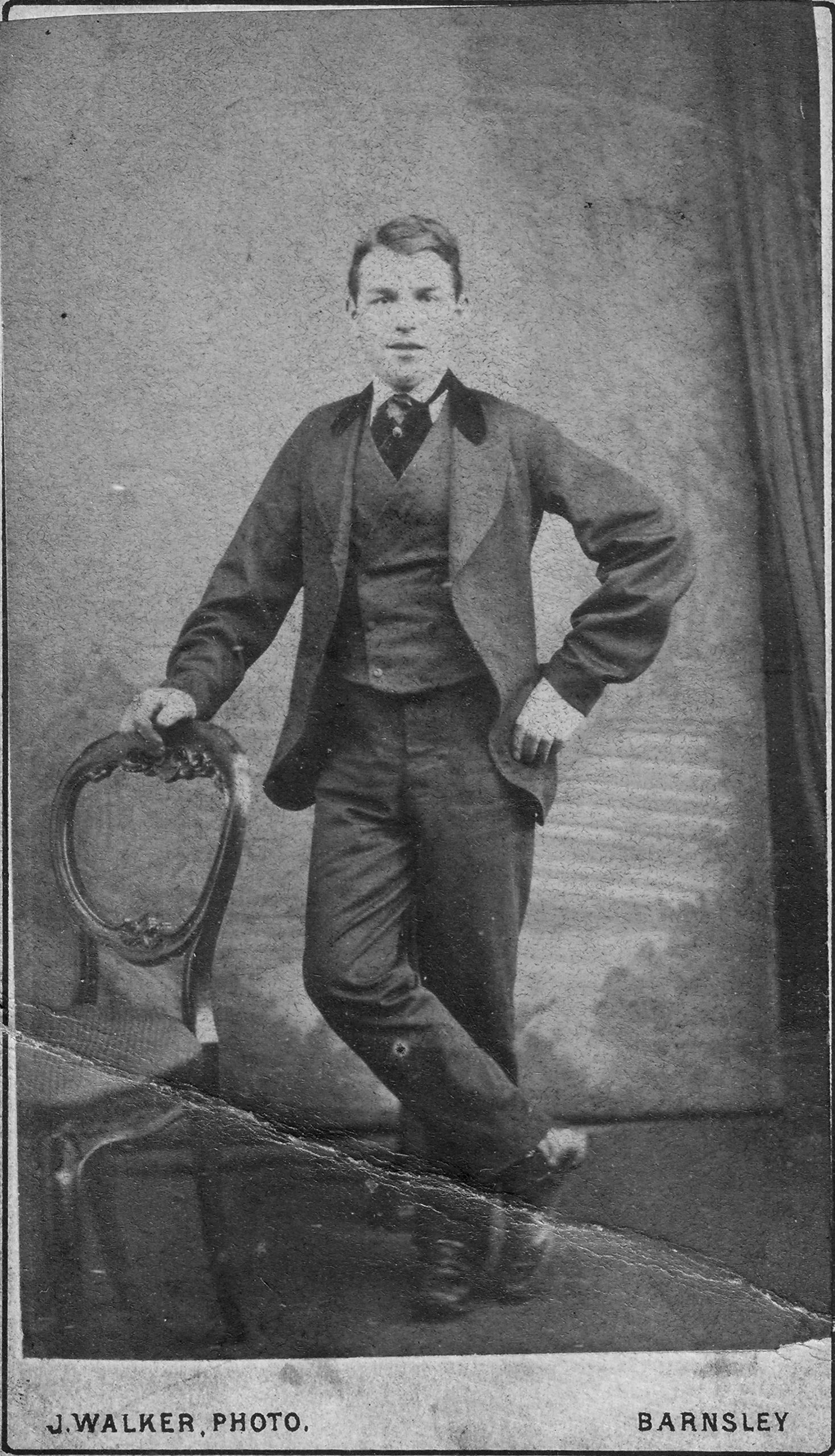
In 1871 Betsy was a visitor at the home of Uncle William and Aunt Emma Hinchcliff (nee Woodcock) in Rotherham, so we don’t know where her permanent residence was aged 13. On April 18th 1876, when she was 18 years old she married 25-year old Samuel Longley, the grandson of a neighbour of her grandparents at Royston. Samuel was a joiner, having previously worked as a pit hurrier during his childhood.
Their first child, Charles Warburton Longley was born on September 9th 1877 in Barnsley. The family must have run into some difficulties soon afterwards. The family story was that Charles was ‘given away’. He was adopted and raised by his paternal uncle William and aunt Sarah Longley. The reasons for this are unknown. Maybe Betsy was ill, perhaps a post-natal mental health problem, and she couldn’t care for the baby. She was very young and would have carried the scars of her own early childhood trauma.
Whatever the problem, she recovered and their second child, Mary Frances (‘Fanny’), was born in Barnsley in 1879.
In the 1881 census the family are living in Skegness. Samuel is still working as a joiner. There would be plenty of work as the seaside holiday phenomenon expanded, and the town grew up by the beach over just a few decades. By then, direct train services from Birmingham, Nottingham and Derby would have brought hoards of city dwellers for their annual seaside break. Betsy had clearly recovered from whatever ailed her back in Barnsley, as they have five more daughters (Bertha, Ellen Gower, Kate, Elizabeth (‘Lizzie’), and Gertrude Emma (Gertie’)) in Skegness during the 1880s, while Betsy is also letting rooms as a seaside landlady.
Then, just as things seemed to be going so well, they packed up and headed back to Yorkshire. By early 1890 they were living in Bradford. Maybe the joinery work petered out in Skegness, or maybe there were richer pickings to be had in the smoky city where endless rows of terraced houses were being constructed to house the thousands of textile mill workers.
During the 1890s they had seven more children in Bradford (John Archibald, Evelyn Maud, John Henry, William Henry, Sarah Annie (‘Annie’), Harold Ernest, and John William) but clearly it was not such a healthy environment for small children to thrive: Ellen died in 1894, aged 10, and four boys died before their first birthday. Of the boys only Harold, survived. Of a total of 14 children, only 8 remained at home. Five had died, and Charles of course had moved away, so Harold grew up as the youngest of eight, with seven older sisters.


The family remained in Bradford, and one-by-one the girls were married and began families of their own. This included Elizabeth (Lizzie) who married George Daft Longthorn in 1913. Harold, the youngest surviving son married Marjorie Sykes Mann in 1922.


The family story that Rob received from his mother and aunt was that when Betsy was in her 40s, in the early years of the 20th Century, and having given birth to 14 children, she was struck down with arthritis, and was increasingly bed-ridden. She was cared for by her daughters.
And then in 1915, as Rob’s mother told it, Samuel ‘was a joiner and fell off a roof’. The newspaper reports are a really interesting insight into the early days of health and safety legislation in action.
Samuel’s death certificate reported that he died of spinal paralysis, consequent upon injuries to the legs and other parts of the body received whilst working on some houses in course of erection in Hastings Street, Bradford, on the 3rd day of May 1914, but how, or under what circumstances his back injuries were received, and whether accidental or otherwise, there is not sufficient evidence to show. The Inquest was held on 2nd Nov 1915.
Betsey made an unsuccessful claim for compensation from Samuel’s employer. Samuel had claimed he slipped from a ladder, but as his body was found on a pile of stones some distance from a ladder or scaffold, and because there was no reason for him using a ladder or scaffold, the employer was found not liable. Reference was made to some payments having been made by the employer, but these were considered an act of kindness rather than an admission of liability.
Rob’s view is the official accounts seem to show is a clever lawyer unreasonably undermining a legitimate case for compensation. Samuel was a joiner, employed in house building. Surely working on roofs would have been a normal part of his work? Why else would he have been up a ladder? However the Inquest was unable to determine if it was an accident or otherwise.


After Samuel’s death, Betsy became increasingly infirm, cantankerous and difficult to care for. It is told in the family that she was passed from one daughter to another, as none of them could cope with caring for her for long. Eventually she was moved into St Catherine’s Home where she died in 1939, aged 80. It was an eventful, and sometimes tragic, life.
Meanwhile her father John Warburton had lost his third wide, Elizabeth Lindrop, to tuberculosis in 1875, aged 45. He married to Elizabeth Bowskill in 1877, and had another son John. Elizabeth died in 1884 of cirrhosis of the liver. John married his fifth wife, and third Elizabeth, Elizabeth Whittaker in 1886. This was his longest marriage and only ended when John himself died on June 9th 1903. The Liverpool Evening Express reported his death as ‘deeply lamented by his wife Elizabeth’.


Leave a Reply