
Updated November 14th 2025: Following an exchange of emails with Rupert Battersby I can clarify certain details such as the date the factory was acquired, and subsequently sold. I’ve also added a link to a short video about making felt hats in Battersby’s Stockport factory, and a letter from Madame Rousseau, then owner of the Conty factory to Walter Battersby dated 1948.
In May, under Hale Barns Clan Update I posted about my new French cousin, who is descended from a Leonard Warburton, a distant cousin of mine who moved to Picardy in the early 1900s to work in a hat factory. The story is that he was recorded in the 1901 census, aged 19, living with his parents in Stockport, and working as a felt hat finisher. Two of his younger sisters were also in the felt hat business. He then moved to Conty, south of Amiens in 1906, married a girl from Amiens in 1907, but divorced in 1938 and returned to Stockport, leaving a line of descendants in France.
I have recently spent a week on holiday in Amiens, along with my wife and sister-in-law, who coincidentally lives in Burgundy about 30 kilometres from my new French cousin. We hired a house for the week and explored Amiens and the area.
Knowing that Leonard Warburton lived in Conty when he came to work as a hat maker, I decided to visit the town, not really expecting to see any evidence of his time there. However we had a big surprise. I found nothing about Leonard himself, but the history of the Battersby Bowler hat factory has left a big impression on the town. The road to the factory was renamed Rue des Chapeliers quite recently, and in 2024 a mural about the factory was added to two sides of an electrical transformer near the Carrefour supermarket.

There is an article (in French) about the mural, with a picture of second side of the transformer here.
I first went to the tourist information office where a lady pointed me to some articles in the local papers. Her printer wasn’t very good so she rang the Library to print them for us. When we went to collect them from the library we were then directed to the place where the factory itself was, passing the English quarter, a row of 8 English style houses, also known as The Battersby Villas, supposedly built for the English foremen and supervisors that went from Stockport to help run the factory.


I wondered if Leonard and his young family must have lived in one of these houses, but have cocluded he probably didn’t, as explained later.

When we got to the factory site it looked private, but we saw a man who invited us to look around. Inside we also found the house the Battersbys occupied. A lady saw us looking through the fence. She turned out to be Aline Andrieu, and she and her husband Andre now own the house, and we were invited in.

The two articles we collected from the library were an article from the France 3 Regions website whose title translates as Battersby Bowler Hats: The Incredible Story of an English Millinery Established in the Somme at the Beginning of the 20th Century and two pages from leMag 2022 about the factory’s role as a hospital in the first world war (scroll down to the article called ‘La Chapellerie’ containing the following photograph) .

The article from France 3 Regions is based on interviews with a local historian, Jean-Michel Renaux, who was in turn in contact with Rupert Battersby, a descendant of the Battersby family, and author of a book: Battersby Hats of Stockport. The article from leMag was written by Jean-Michel Renaux.

Although the France 3 Regions article states it was in 1902 that the Battersby family, proprietors of a large factory in Stockport, near Manchester, decided to open a factory in Conty, an entry in the diary of William John Battersby the proprietor of the Stockport business, dated 5th March 1906 says “To Conte and place bought”. He had probably been searching for a place for some time as a diary entry from 11th March 1896 says “To Beauvais – Factory no good,”
The France 3 Regions article indicate that two cousins, Walter and Edgar were sent to run the Conty factory, and Walter ran the factory until the late 1930s when he returned to Stockport.
Walter and Edgar were actually brothers, younger sons of William John Battersby, proprietor of the Stockport factory. However it was Charles Harold (known as Harold) and Ernest, two of William John’s other sons, who were located in Conty. There were 7 brothers in total, plus 2 sisters, and 2 other boys who died in infancy. Walter did spend two years in Paris after his wedding in 1909, and visited the factory in May 1920,. He may have visited at other times but was primarily based in Stockport. The factory was sold to a Mr and Mrs Rousseau in 1922. Walter stayed in contact with the new owners, as evidenced by the letter (see below) from Madame Rousseau dated 1948.
Edgar’s speciality was felt dying and he was also based in Stockport, though he may have visited occasionally. He enlisted as a Private in the Honourable Artillery Company in November 1915, aged 35. He was killed in action at Gavrelle, near Arras on Aril 29th 1917. Although most records correctly give his rank as Private, a memorial in St Alban’s church, Offerton refers to him as Captain.
Censuses for the Somme region are available on Ancestry for 1906, 1911 and 1921. The 1906 census was taken at the end of March, and it recorded Harold Battersby a hat maker in Rue Rigollot, Amiens, and Leonard Warburton, Harry Bradshaw and Lambert Pendlebury as chapelliers in Rue Vascopin, Amiens and employed by Battersby.
In 1911 Harold, and Ernest are living at La Fabrique. Harold is the Patron and Ernest his brother. Harold was responsible for marketing and sales, whilst Ernest probably handled production, though his worsening TB meant he spent winters in Cannes and Nice. Leonard Warburton, Lambert Pendlebury and Harry Bradshaw are also present , They all have wives, and Lambert has 2 children. Leonard and Lambert are living in Rue des Hargars, and Harry in Rue Verte.
Harold’s birth was registered in the first quarter of 1872 as Charles Harold. Curiously he is omitted from the Wikipedia list of William John Battersby’s children, though he is present with the family in censuses up to 1901. Harold died in Conty in 1913.
Ernest is also known from a letter he received from Joseph Haumesser, Dean of Conty, who ministered to the severely wounded soldiers housed in the Battersby house and factory during the Great War. Ernest is described as living in Conty, but of fragile health, having contracted TB. He died at Yvetot, Southern France in October 1918. Walter made a hazardous journey across wartime France to be with him when he died.
The factory actualy made felt hats in general, not exclusively bowler hats. It was powered by a mill located on the Selle, a tributary of the Somme. The hats were moulded onto moulds in ovens using steam. This was a laborious task, usually performed by men. The material used was felt, made from rabbit hair imported from Australia. A 3 minute video of the felt hat making process in Stockport can be seen on YouTue here.
It is estimated that 10% of the population of Conty was employed by the English factory, around a hundred employees. These were mostly women, who worked in the factory or at home.

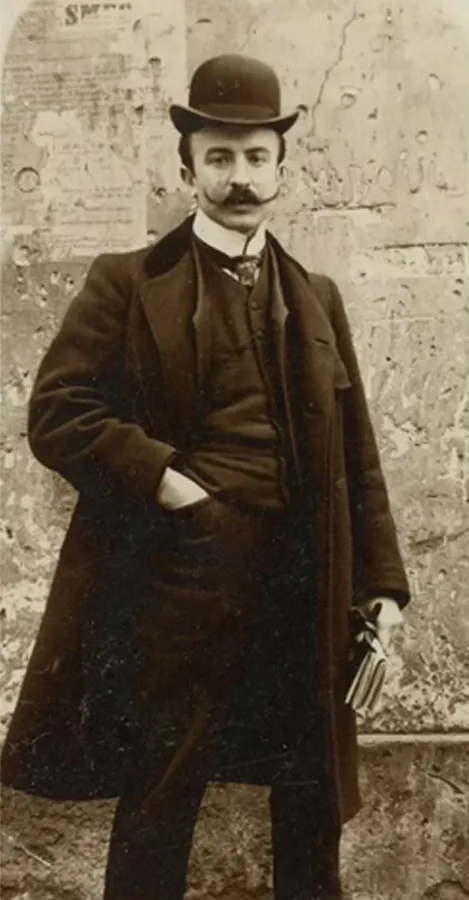
The bowler hats were of very high quality, with perfect finishes, and were exported all over the world with the ‘Battersby-Conty’ crest.
In the First World War Conty, 20 kilometres SSW of Amiens, was very close to the front lines. The German advance in 1914 captured Amiens and came very close to Conty before being pushed back to the north and east of Amiens, which became a major logistical and recreational centre for British troops. In 1918 the German Spring Offensive was aimed at capturing Amiens but the advance was stopped short of the city.
The Battersby factory played an important role during the war. Conty was then considered a rear base for rest and care for the most seriously injured soldiers. The house and part of hat factory were requisitioned to be transformed into a hospital, but also into a parking centre for military vehicles. The most seriously injured were treated there.
The letter from Joseph Haumesser to Ernest Battersby was written in April 1918, during the German Spring Offensive. The dean writes that he is a frequent visitor to the house. The hat shop is still operating, but some workshops are requisitioned to accommodate the seriously wounded who arrive every day. Many die in his arms. “In 12 days, I buried 102 heroes admirably resigned to the sacrifice of their lives for God and country.”
He writes that the house has become a place of suffering. The dining room is transformed into an X-ray room, the living room converted into an operating room, and the large room into an infirmary for the dying. Sometimes in the buildings, there are 700 to 800 wounded, some of whom leave in the evening, leaving only amputees and desperate cases.
He also describes the incessant cannonade: “those terrible lights that illuminate the horizon in front of Ailly-sur-Noye every night. It is frightening to hear the great naval cannons ringing over the Bosquel and Essertaux plateaus, and then, since yesterday, the siren sounds the alarm of the German planes, shining in the sky during the day like white midges and at night rumbling like demons”.
He also shares his state of mind: “War is misery, it makes you irritable. This morning, I received an English captain, who has come to take command of an anti-aircraft force. Moreover, the headquarters of an army is in Conty . We therefore become the centre of the battle. I can’t leave, because if I did, Conty would panic and everyone would rush there. I believe the situation is under control in front of Conty; the Germans won’t get through.


“No matter what, we will win, we will have confidence and patience.”
After the war the factory continued to make hats, but was not properly revived. The 1921 census for Conty reflects a declining Battersby influence. Both Harold and Ernest had died and no other Battersby had replaced them. However the census includes an area named Usine et Cite Battersby, and the first family in the area is the English family of Ernest Bracegirdle, Directeur d’usine, his wife and daughter. The daughter later married Arthur Hamer, the head dyer at Stockport. The only one of the three Englishmen listed in Amiens in 1906 still present is Harry Bradshaw, still living with his wife in Rue Verte.
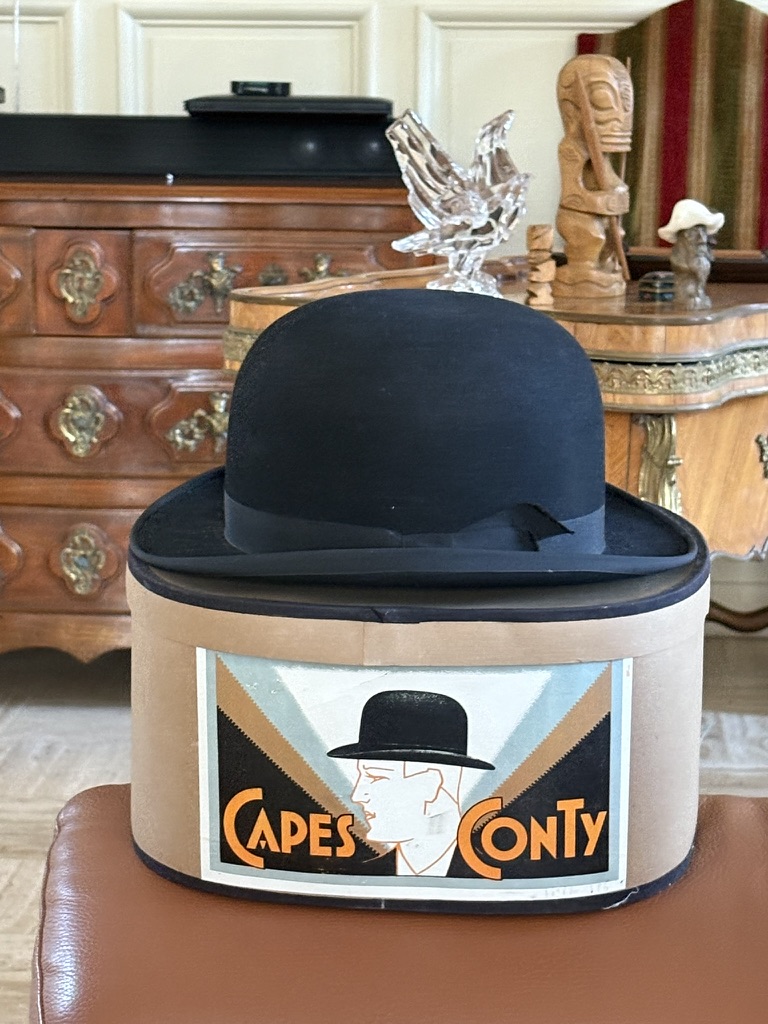
This hat is in the possession of the Andrieu family, the current owners of the Battersby House. It was made at the Conly factory in the post Battersby era. The photo was taken by me on our visit in October 2025
The factory was sold circa 1922, and apparently diversified into women’s hats. However it seems the production of bowler hats continued, to the astonishment of the invading German soldiers in WW2 who sent examples home to their families in Germany.
The new owners, Mr and Mrs Rousseau, maintained close ties with the Battersbys, as evidenced by a letter dated 1948 from Madame Rousseau to Walter Battersby. The following image was kindly sent to me by Walter’s grandson, Rupert Battersby.


The letter is addressed to Monsieur Walter Battersby, Offerton Works, Stockport, England. With the help of my sister-in-law and her French friends, my best translation is as follows:
Dear Mr. Walter,
One of my old friends Mr. Rene Molist is visiting England – I have asked him to visit in order to nurture certain projects. My daughter is currently very anaemic and is having a consultation with a specialist in Paris this week. We fear she will be there some time to take refuge in a more favourable climate.Despite the crisis caused by ‘Hatlessness’ the factory is working fairly normally, thanks to exports. I shall be pleased, when my friend returns, to speak to him about you and the chances of you coming again to France? I am coming back from Cannes where there is a beautiful colour of abroad . At the moment I am in discussions about a delightful little apartment on the Croisette. Assuring you of my old and loyal friendship,
Lety Rousseau
The letter implies a close relationship with Walter more than a quarter of a century after the factory was sold, as it includes quite intimate personal details. Also the dispatch of Mr Molist to Stockport to nurture certain projects implies an ongoing business relationship. The reference to the Croisette in Cannes implies Mme Rouseau is planning for her retirement, which soon came to pass as the factory finally closed in 1951. Walter did meet Mrs Rousseau again in the 1950s.
The picture of the factory on the letterhead shows how extensive it was, and is very similar to the one in the mural on the electrical transformer near the Carrefour supermarket

Leonard Warburton was in Amiens by the end of March 1906 when he appeared in the census. He married a girl from Amiens in May 1907, and had three sons born in Conty. The eldest died in infancy before the 1911 census where Leonard is living in the Rue des Hargers with his wife Louise.
Leonard’s other two sons were born in 1913 and 1916. In 1917 he enlisted in the army where he was recorded as a French translator. He received wounds to both thighs, and was repatriated to Conty in 1919. His address was still given a Rue des Hargers.
On the modern Google map Rue des Hargers is shown as parallel to the Rue des Ecoles where the English houses are situated, Rue des Ecoles doesn’t appear in the old censuses so may have been named later.
In the 1921 census there is an area named Usine et Cite Battersby, that is distinct from the Rue des Hargers. The old postcard of the houses, shown above, refers to them being in the Cite Battersby. It is unclear when these houses were built but it seems doubtful that Leonard, or any of the English chapelliers ever lived in them.
Leonard is not in the 1921 census for Cony, and according to my cousin Karin is known to appear in the 1931 census for Decize in Burgundy. Unlike the Conty censuses that appear on Ancestry.com, I cannot find the Burgundy censuses online on any English site. It would seem that he left Conty between 1919 and 1921. I don’t know if he appeared in earlier censuses in Decize, or elsewhere, and what his occupation was recorded as. It would seem likely he moved to continue his trade, probably directly to Decise, but an interim location cannot be discounted. He divorced in 1938 and returned to Stockport. In the 1939 Register he is living with his father and described as a felt hatter, and manager. I don’t know if he had returned to work at the Battersby factory.


Leave a Reply